Wednesday, July 13, 2011

Mini-Series Post #6: No Turning Back

A few months ago, I remember feeling extremely nervous thinking about the fact that I would be living a mere 55km from the DMZ (and North Korea!) for a month.  There is nothing more frightening than living next to the most secretive country in the world:
This image, courtesy of Google Maps, shows North Korea as a blank chunk of land.  We have no knowledge of the cities and roadways.  (Please note the Korean text on the map; my internet is almost always in Korean here.)  What is scarier than the unknown?  A universal unknown, like death?  I'm not quite sure I can think of anything.  Fifteen HISS students, primarily from the States and the Netherlands, have decided to take a tour to the Joint Security Area (JSA) and Panmunjom (located inside the DMZ) on Wednesday, July 20th.  The tour departs at 8:50 a.m. from the Panmunjom Travel Center in Lotte Hotel.  It costs W77000 per person, but in my opinion, such an opportunity is completely worth the expense.  There are very strict tour rules, including background checks for visitors from certain countries, dress code, and age restrictions.  Americans are not allowed to wear clothing promoting the U.S.  All visitors are required to wear pants (without holes), shoes (not flip-flops), and shirts that are plain and cover the shoulders.  A friend who has taken this tour, Gera, told me that this is required because the North Koreans sometimes take photographs of the South Korean and foreign visitors and use them as propaganda, telling the North Korean population that South Korea is too poor to properly clothe its people.  

Panmunjom is the closest location to North Korea for visitors to see.  It is the truce village between North and South Korea established on the ceasefire line at the end of the Korean War in 1953.  At that time, only an armistice was signed - not a full peace treaty.  Tours used to run to Kaesong and Geumgangsan inside North Korea, but they have been suspended since 2008 by the North Korean side.    

The Seoul City Guide mentions these things about the JSA (p.162):  

  • "In the past a gun battle and gruesome axe murders have taken place in the JSA, but the last serious incident was back in 1984"
  • "The Berlin Wall seems like a child's toy compared to this sucker" 
  • "It's probably the most heavily fortified border in the world - high fences topped with barbed wire, watchtowers, an antitank wall and obstacles"     
For more information about my specific tour, click here.

For those readers looking for information about North Korea, here is a very interesting documentary on YouTube called Welcome to North Korea.

Monday, July 11, 2011

Mini-Series Post #5: Stereotypes & Perspectives

Today was another slow day of class.  It's so hard to sit inside for six hours when there are so many things I still want to do while I'm here!  Luckily, tomorrow is Tuesday, and we don't have classes on Wednesdays.  Many of us plan to try the unstrained rice wine tomorrow, called makkoli.  This is a drink that goes well with bindaedduk, or mung-bean pancake.  Rice wine has a much lower alcohol content than soju, the vodka-like equivalent in Korea, and is a milky color.  I can't wait to try it!  After that, we will likely go to the clubs in Hongdae - I still have yet to do this!  On Wednesday, we have a field trip to the Hyundai Motor Factory and another trip to Insadong.


On Saturday night, a few friends and I went out for drinks at a local bar.  We went out with a guy from the Netherlands and his friend, who has been living in Seoul for three years.  Eventually, we got to talking about stereotypes.  I asked them for the American stereotype:  "Be completely honest - I'm sure I've heard what you're going to say," I said.  They were hesitant at first, obviously not wanting to offend us.  This, of course, peaked our curiosity.  


Basically, the stereotypes of Americans they were accustomed to included the image of the "ignorant American," who knows nothing about the world beyond American borders.  I couldn't help but somewhat agree - it amazes me how little some people know about the world.  They also mentioned that some stereotypes include Americans as selfish and rude in foreign countries.  The guy who has lived here for three years, Raul, showed us a picture on his phone of a "no admittance" sign for U.S. Army members at a bar in Seoul.  "They think they own the place," he said.  "They are destructive and rude and think they are allowed to act that way here.  In my experience, they are not well liked here."  This was really embarrassing for me.  U.S. Army members acting so awful that they are banned from certain restaurants and bars?  Really, all I can do in those situations is remember that I am doing my part as a "global citizen" - I am genuinely interested in other countries and open to different perspectives.  That's really all I can do - worry about myself and how I act when I'm abroad.  


Other instances during which I felt embarrassed while I've been here include moments in class when we discuss the countries we've been to and the languages we speak.  Other students are fluent in two, three, and four languages! I speak English and could get around a Spanish-speaking country.  I've been to one other country.  These students have been all over the world - a trip to Seoul was not monumental, but instead, another stamp in their passports.  I guess I shouldn't feel embarrassed about that - I am a good student, I try hard and I'm involved.  Still, to know that others are such better "global citizens" than me is somewhat unsettling!

Sunday, July 10, 2011

My First Trip to Insadong

Insadong is even better than I imagined.  While there are many foreigners flooding the busy streets of this cultural district, it is easy to turn off onto a quiet, winding side street lined with tiny tea houses, restaurants, and little knick-knack stores.  Insadong seamlessly blends the old with the new, offering impressive modern shopping centers like this one while maintaining its ties to traditional Korean culture on the side streets.
A modern shopping complex in Insadong
Traditional restaurants off the beaten path in Insadong
My first priority in Insadong was to find a traditional tea house and try some cha.  "A cup of tea costs around W6000 (as much as a cheap meal), but it's a quality product and often served with a rice-cake snack," the Seoul City Guide acknowledges (114).  Inside the tea house, soothing instrumental music played quietly while customers talked over their tea and rice snacks.  We ordered several different types of tea:  citron tea (iced & hot), cinnamon punch tea (iced) and five-tastes tea (iced).  With our tea, we were given complimentary rice cakes.
The tea house we visited.
Inside the tea house.
ONU students enjoying tea in Insadong.
It was a very enjoyable experience and I plan to try another tea house, Yetchatjip, where "half a dozen little song birds fly around inside" (116).  "Antique bric-a-brac so clutters this hobbit-sized teashop that it's hard to squeeze past and find somewhere to sit" (116). 

Saturday, July 9, 2011

International Party & NANTA

It has been a busy few days for me!  I can't believe it's Sunday already and I only have one weekend left here.  On Friday night, the HISS hosted the International Party:
The coolest university-held event I've ever attended!
In case you missed some of the details, this party included unlimited & free alcohol.  No one believed that this was an actual school-hosted event, but no one was complaining, either.  The party was held at Viaerae, a little bar/restaurant/club in Wangsimni.
Viaerae in Wangsimni
Drinks included mojitos with fresh lemon and lime, sangria, beer, and shots.  I am a little interested in how expensive this was, since there were probably between 200-300 people there.  The bar had to stop serving at 12:30 a.m. because it had run out of most drinks.  There was dancing in the club basement of Viaerae, where various contests were held (including handsomest guy/prettiest girl, best male dancer/best female dancer).  When we entered the party, we were given glow stick bracelets that we were told to hand out to the guys or girls we thought were best dressed/handsome/pretty.  I mostly gave mine out to my friends, not taking the whole thing too seriously.  However, by the end of the night, I had received around 22 bracelets from all kinds of people, thus winning the prettiest girl competition!  
Mom and Dad will be so proud! 
I won this hat, which says "beautiful flower girl" in Korean.
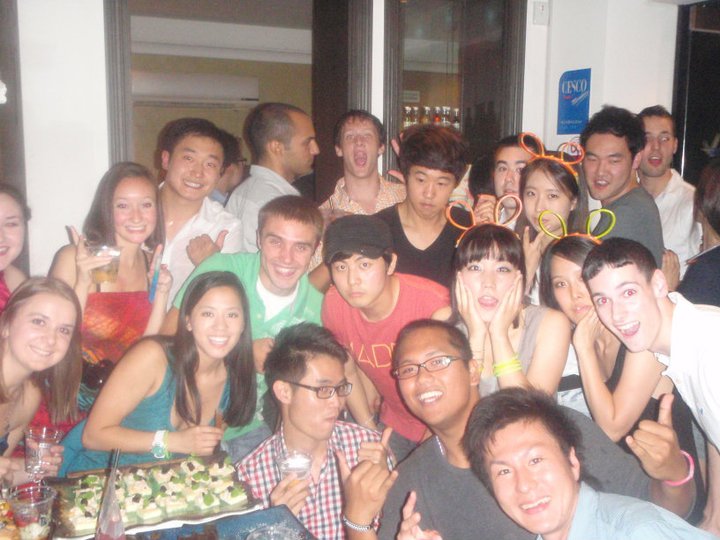
This was the best night we've had so far and it was so much fun to hang out with everyone finally.  Usually, we do things in separate groups, so this is the first time we've all been together socializing at an event:
We say "kimchi!" instead of "cheese" for photographs!
On Saturday, we attended NANTA, a show in which the performers transform knives and other kitchen utensils into musical instruments.  The show was energetic and exciting, as the performers did tricks with knives and fire and played the drums on anything and everything.  Essentially, it is like the show Stomp! but in the kitchen.  

Today, we plan to visit the "craft capital" of Korea, Insadong.  The area offers more traditional Korean culture with atmospheric tea shops, wonderful restaurants, and Korean clothing & craft shops.  

Yesterday, we hit the halfway point in our trip.  Many of us are beginning to realize that a month is actually a short amount of time in such an awesome city.  Hopefully we can find time to do all that we still want to do!

Thursday, July 7, 2011

Mini-Series Post #4: "Midterm" Week

It's been a relatively unexciting few days, as it is currently "midterm" week (during my second week of class - hah!)  However, I've got a few exciting things to look forward too:
  1. International Party tonight, hosted at a bar in Wangsimni.  There is unlimited free alcohol and the dress code is "hot," according to the flyer posted around campus.  I'm looking forward to meeting more people in the HISS!
  2. Nanta performance on Saturday night, the "Broadway" of Korea, and "one of the best shows you'll ever see!" (The Scotsman)
  3. Clubbing in Hongdae Saturday night for my first time 
  4. Insadong on Sunday to view traditional Korean culture
  5. A tour to the DMZ (Demilitarized Zone) and JSA (Joint Security Area) - yes, I am doing it!  I am so excited.  A group of students are looking at tour dates...tentatively, we are thinking 7/20, as we don't have class on Wednesdays.  This tour looks like it costs 77,000 won ($77) but will be totally worth it.  Closer to our tour, I will do an informational post about these areas.  Noted as the "most dangerous place on earth," the DMZ is the most heavily guarded border on the planet.  
On an unrelated note, my lovely boyfriend, Greg, sent me 1-year anniversary flowers from Ohio.  Only he could pull that off:
Beautiful flowers from Greg
Thanks, Greg!  They are beautiful :)

Wednesday, July 6, 2011

Korean Baseball!

Instead of saying "I hate watching baseball" from now on, I will say instead "I hate watching American baseball."  Today, we traveled to Jamsil to watch the Doosan Bears play against the Lotte Giants.  The crowds were so enthusiastic, which made the game much more enjoyable than American baseball!  Also, the game was much more exciting - there were actual hits and runs made. 
The enthusiastic crowd
Most of the songs the crowds sang in Korean to the tunes of American songs, such as the "I Love You Baby" song that Heath Ledger sings in 10 Things I Hate About You.  The songs were so loud and on tune - it was so awesome to see such a collectively happy group of people.


Around the 6th inning, people began to pass around orange bags.  We had no idea why until we watched others filling them with air and tying them on their heads.
The most interesting hats I've ever seen.
Ladies and gentlemen, I have never seen anything like this before.  After we stopped laughing over how funny/dangerous it was, we (of course!) had to join in on the fun.
When in Rome!
That's a picture of two ONU students - Jacob & Scott - wearing their bag-hats proudly.  I feel like this is somewhat dangerous, especially with children, but that's okay.  

Tuesday, July 5, 2011

Mini-Series Post #3: A Culture that Encourages Responsibility

Perhaps one of the most interesting differences I have noticed during my time in Seoul includes Korean culture's efforts to encourage social and personal responsibility.  For example, in almost every building I have been inside, various receptacles for plastic, paper, aluminum, and waste orderly sit beside one another.
Separate receptacles on each floor of the dorm. 
Obviously, I can't read the Korean, but I just look inside to see where I'm supposed to put things.  To see such a collective ecological effort is so refreshing!  As I walk down the street, I see shopkeepers everywhere sorting through waste and recyclable materials.  Even at fast food restaurants, there are separate receptacles for all of the waste.  To many Americans, this may seem tedious; however, I think it is absolutely fabulous.  I try to recycle at school, but sometimes, I throw a can in the garbage, thinking, "how far does one person's effort actually go?"  Seeing Korea's recycling effort has reinvigorated my desire to save the planet, one pop can at a time.

In addition to social responsibility, Korea encourages personal responsibility by publicly displaying the calorie counts on the menus of many fast food restaurants!  I was shocked to see this for the first time and I can't believe we have not done this in the United States, since obesity is such a huge issue.  Let's face it, not many Americans go to a website to find additional nutrition information and calorie counts.  With the calories staring back at you while you observe the menu at MacDonald's, wouldn't you feel a little guilty eating a Big Mac?  I know I would never step foot in a fast food restaurant again.